

In recent times, Bitcoin dropped below the significant level of $90,000. This action was not unexpected to even the most seasoned market observers, but it was a clear indicator of an increased sense of caution among investors. Traders minimized the risk since they were awaiting significant economic news in the United States and other economies of the world.
This article discusses why Bitcoin fell, the significance of the $90,000 mark, macro influences on crypto, and the next following to monitor by investors.
Bitcoin Breaks Below $90,000: What Happened?
The bitcoin dropped to less than $90,000 in a low trading action period. A variety of traders remained sidelined. They were risk averse as major economic events were on the way.
Reduced liquidity enhanced sharp price movements. Small sell orders can have the effect of pushing prices down even when the number of people who trade is less. This condition contributed significantly to the downfall of Bitcoin.
Simultaneously, a great number of altcoins demonstrated weakness. This was a major weakness that decreased the overall market confidence and increased pressure on Bitcoin.
Why the $90,000 Level Matters
The $90,000 mark served as a good psychological support area. A significant number of traders had buy orders around this price. They felt that Bitcoin would reach this level.
Bitcoin dropping to less than $90,000 was an obvious sign. Buyers stepped back. Sellers acquired short-term power.
These price levels are important since they influence the behavior of the traders. Traders usually wait to be confirmed before returning to buy again once Bitcoin has fallen below a key support level.
Take a look at Bitcoin Halving 2028: Early Prep
Low Liquidity Increased Market Volatility
Bitcoin dropped in a silent trading schedule. The trading volume is usually less on weekends. The number of traders who remain active during such hours is low.
Reduced liquidity causes fluctuating price action. Prices slide around at a greater rate. The stop-loss orders may be provoked by a minimum selling, which drives the prices further down.
Such conditions do not necessarily indicate long-term ineffectiveness. It tends to be wary in the short-run and ineffective in the market.
Investors Turn Defensive Ahead of Economic Data
The traders minimized exposure to play as economic key reports were near to hand. Such reports have the ability to impact interest rate choice and the market mood.
Investors prefer clarity. As the uncertainty increases they drift to safer grounds. This tendency has its impact on risky investments such as cryptocurrencies.
Bitcoin tends to respond to the world’s economic signals. As the investors anticipate more stringent situations, they reduce risk-taking.
Key U.S. Economic Triggers to Watch
There are a number of U.S. economic indicators that affect Bitcoin price changes. These are the points that the traders keep an eye on.
| Event/Date (Dec 2025) | Description | Potential Bullish Impact | Potential Bearish Impact | Bitcoin Historical Reaction |
|---|---|---|---|---|
| U.S. Employment/NFP (Early Dec) | Jobs data, unemployment rate | Weak data → rate cuts, BTC rally | Strong data → delayed cuts, risk-off | +5–10% on soft landings |
| U.S. Inflation/CPI/PCE (Mid-Dec) | Core inflation metrics | Lower inflation → liquidity boost | Higher → hawkish Fed, BTC dip | Volatility spikes 10–20% |
| Fed Speeches/FOMC (Ongoing) | Policy tone updates | Dovish → BTC surge | Hawkish → defensive selling | 5–15% moves post-speeches |
| Japan Rate Decision (Dec 19 est.) | Potential hike to 0.75% | Global liquidity ease → BTC up | Tightening → risk aversion | Correlated drops in past |
| Overall Macro | Combined data releases | Positive surprises → rebound | Negative → deeper correction | Low volume amplifies swings |
Employment Data
Job numbers show the power of the economy. High employment increases might postpone interest rate reductions. This scenario tends to stress risky assets.
Inflation Data
Central bank decisions are based on inflation reports. Borrowing costs are usually high due to high inflation. This situation lowers the risk appetite.
Central Bank Speeches
The expectations of the market are influenced by the statements of the central bank representatives. Markets can be moved even with minor changes in tone.
Bitcoin traders observe these indicators before taking huge steps.
Similar post you can read: CryptoPotato: Bitcoin $90K Support Break
Global Events Add to Market Caution
Bitcoin is also affected by the global markets. External events in the U.S. are also significant.
Japan’s Interest Rate Decisions
The central bank of Japan has intentions to change interest rates. Tightening can have an impact on world liquidity.
The risk assets in Japan are promoted through low-interest borrowing. As rates increase, this support becomes weak.
Impact on Global Liquidity
Stricter policies lower the flow of easy money in the system. Bitcoin tends to respond adversely to decreased liquidity.
Traders are aware of this connection and position in advance.
Altcoin Weakness Signals Broader Risk-Off Mood
Bigger altcoins displayed worse losses than Bitcoin. This pattern showed a risk-off attitude throughout the crypto market.
The traders sell out smaller assets first when they lose confidence. They transfer money into Bitcoin or stable items.
This trend was quite evident in the recent downfall. Bitcoin was relatively strong even though it lost support of $90,000.
Bitcoin Dominance Remains Strong
The decline did not lower Bitcoin dominance. This indicator represents the proportion of the total crypto market value of Bitcoin.
Signs of high dominance suggest selective purchasing. Bitcoin is a more reliable digital asset to all investors in the season of uncertainty.
This is an act of caution rather than panic.
Technical Levels Traders are Watching
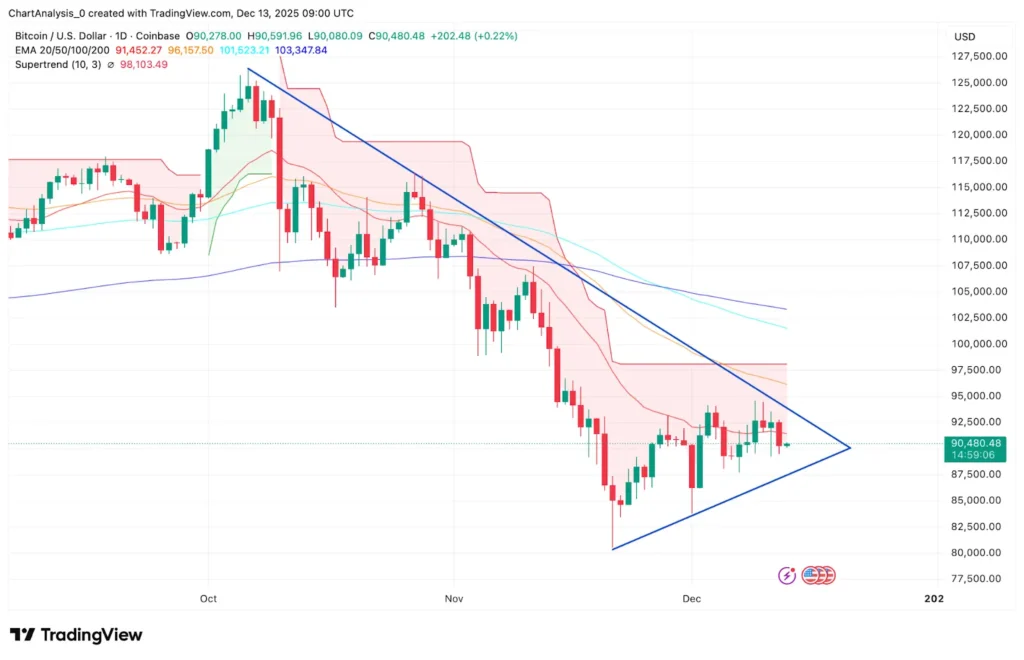
Traders currently look at new levels of support.
| Level Type | Price Level | Significance | If Held | If Broken |
|---|---|---|---|---|
| Resistance | $90,000 | Psychological barrier; recent high | Caps rally; defensive mood | Reclaim → bullish reversal |
| Support 1 | $86,000 | Critical zone; volume node | Stabilizes; potential bounce | Panic to $83–$85K |
| Support 2 | $83–$85K | Deeper floor; stop-loss cluster | Temporary bottom | Test $80K or lower |
| Long-Term | $80,400 | Major macro support | Strong rebound potential | Bear market confirmation |
$86,000 Support Zone
Analysts consider the threshold of $86,000 to be critical. Bitcoin should retain this space to prevent further losses.
Resistance Near $90,000
Bitcoin is currently encountering some opposition at the former support level. The price has to recover this point to have a resurgence of bullish movement.
Short-term trading decisions depend on technical levels.
Is This a Trend Change or a Temporary Dip?
It is the question that every investor would be interested in.
Bitcoin continues to trade in a broader scope. Long-term trend patterns were not yet violated by the price.
Temporary declines tend to occur in unpredictable macro times. A high number of traders hold back on making long term conclusions.
It is a step that is full of precaution rather than failure.
How Market Sentiment Shapes Bitcoin Price
In the short run, price moves determine markets more than fundamentals.
Prices decrease when the traders get nervous. As soon as there is confidence back, prices go up.
Sentiment is affected by news, data releases and situations within the central bank.
Bitcoin is more responsive compared to the traditional assets because it is a global asset.
The Role of Institutional Investors
The world of large investors contributes to Bitcoin prices driven significantly.
Risk reduction always comes before significant economic events. They hedge capital and lay back to wait.
Such action may lead to short-term price declines. It is not always an indication of those against the future of Bitcoin.
Once the uncertainty has been addressed institutions often re-enter.
Why Bitcoin Still Holds Long-Term Strength
Regardless of the short-term weakness, Bitcoin continues to have a few long-term strengths.
- The scarcity of supply justifies long term value.
- Increasing adoption raises the demand.
- The interest of the institution is high.
- International popularity is increasing.
These considerations favour Bitcoin when the market is declining.
How Retail Investors Should React
Retail investors must not make emotional decisions.
Fear is commonly driven by short-term price fluctuations. Long-term plans matter more.
Investors should:
- Avoid overtrading
- Use proper risk management
- Focus on long-term goals
- Stay informed
Investor patience is usually rewarding.
Risk Management Becomes Crucial Now
Risk control is needed in uncertain markets.
Investors should:
- Set clear stop-loss levels
- Avoid excessive leverage
- Diversify holdings
- Keep emergency funds
Good risk management protects capital during volatility.
Why Bitcoin Reacts to Macro Events
Bitcoin trades globally. Economic events impact every market.
The behavior of investors is affected by the interest rates, inflation and liquidity. Bitcoin is fast to react to these aspects.
With the further maturation of Bitcoin, the ties with the world markets become closer.
This correlation is the cause of the recent price changes.
Market Volume Remains Subdued
The trading volume remained low throughout the decline. Low volume indicates that there is no vigor in selling.
High volume confirms trends. Poor volume is an indicator of indecision.
This trend promotes the concept of a temporary disruption and not a significant break down.
What Could Push Bitcoin Higher Again?
Bitcoin could recover several factors.
- Positive economic data
- Softer central bank tone
- Improved market liquidity
- Strong buying near support
These factors could rebuild confidence in a short time.
What Could Cause Further Declines?
Downside risks still exist.
- Strong inflation data
- Hawkish central bank indicators.
- Global market stress
- Breakdown below key support
These risks are the ones that traders need to keep an eye on.
Short-Term Outlook for Bitcoin
In the near future, Bitcoin is prone to sideways trade. The big moves are usually preceded by markets being consolidated.
Traders follow economic indications in order to have a clean signal. Volatility can also intensify due to release of data.
Short term patience still holds importance.
Long-Term Outlook Remains Constructive
Bitcoin continues to be valuable to long-term investors.
The trend has been positive on adoption. The institutional interest prevails. Supply remains limited.
Temporary declines usually open long-term prospects.
Key Takeaways for Investors
- Market caution led to Bitcoin losing $90,000 support.
- The lack of liquidity enhanced price movement.
- Macro events fuel the existing sentiment.
- Long term framework still in place.
- Risk management is more important than ever.
By knowing these, investors will be able to make wise decisions.
Final Thoughts
The loss of $90,000 in support shows warning rather than panic on Bitcoin. To major economic triggers, markets became defensive with traders expected to welcome market shocks.
This step reflects the increased involvement of the crypto-currency in the international markets. Economic information has become very important in price movement.
Investors must remain composed, remain aware, and concentrate on long-term plans. There is still short-term volatility in the path of Bitcoin.
When clarity becomes restored, confidence can be restored also.